How to Implement Signal-Based Outbound in a Small B2B Company: 7 Takes From a Marketer Who Runs It
TL;DR: For a small B2B company, signal-based outbound is usually a better fit than high-volume outbound, but the signal is the easy part: everyone sees the same funding rounds and new hires at the same time. What sets you apart is the checks between the signal and the email. Start from your own won and lost deals, decide who you won't write to, and do the cost math before you build. Then run the cheap checks before any AI, build every email from checked facts, and test segments built around situations, each measured on its own.
There's a scene in The Founder I keep coming back to. Before building their new kitchen, the McDonald brothers took their staff to an empty tennis court, drew the layout in chalk, and tried different arrangements until the orders flowed. Only then did they build it.
That's how I think about outbound now, and about inbound too. Before any automation, you need a system that stands on two things: analytics and human judgment. Analytics tells you which companies are worth a message and when. Judgment decides what to say, and whether to send it at all.
Most advice on signal-based outbound starts with the signals: track funding rounds, new hires, pricing page visits, and stack as many as you can. It's good advice. It's just not where most of the work is.
A signal tells you when a company might be ready to buy. I wrote about that timing problem in what revenue analysis misses about B2B SaaS growth. This article is about everything that has to happen between the signal and the email.
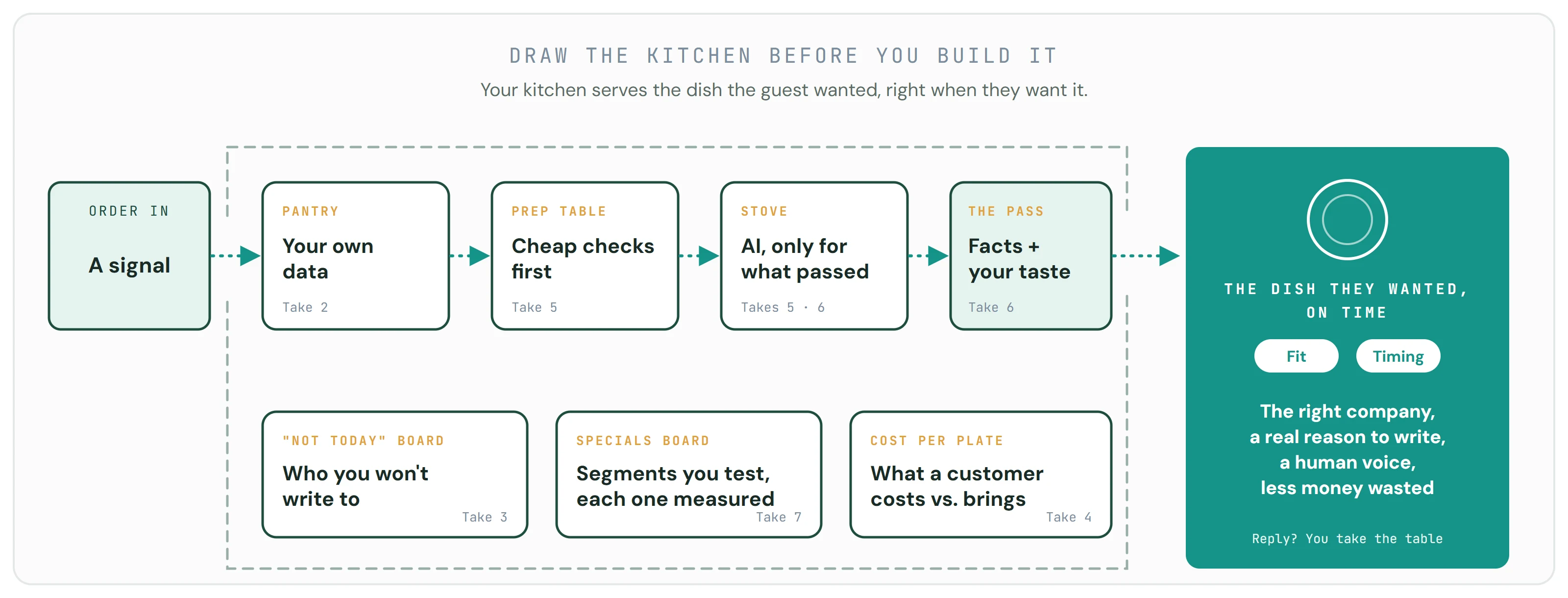
1. Signal-based or high-volume outbound: which is right for your company?
For a small B2B company, signal-based outbound is usually a better fit than high-volume outbound, because you can't afford to burn your domain or your market on a list. High-volume outbound needs huge lists and accepts mistakes. Signal-based outbound sends fewer emails, but each one needs a reason. That reason holds up only if a system checks it first.
Signal-based outbound means writing to a company only when something visible has changed there, such as a new hire, a funding round, or a launch, instead of working through a static list. High-volume outbound can still fit when deals are small and you need to test a new message fast. Signal-based is harder to scale: only so many companies are in the right situation at any moment.
Take 1: High-volume outbound didn't survive my first check: a quarter of my list was wrong. I chose signal-based, because I'd rather send fewer emails than spam the market I sell to.
I learned this the classic way. When I started selling my revenue analytics work, I planned to do it with cold email. So I did what most founders do: I bought a list from a contact database.
Before sending anything, I ran the list through an LLM and split the companies into segments by what each business actually does. Then I checked the websites. About a quarter of the list didn't fit: what the database said these companies did didn't match what their own websites said.
That was where I stopped. If I sent those emails, many would land with people who had no reason to read them. An email to the wrong person isn't outreach. It's spam. I could also see this wasn't a one-time test. There would be many experiments, and I needed a place to keep the data and track what worked. So I started building a system instead of a send list.
Today, the signal part is easy to get. Two of the biggest CRMs now ship AI agents that watch for funding rounds and leadership changes, score accounts against your ICP, and can send emails with no review at all. Everyone sees the same signals at the same time. The signal alone doesn't set you apart. What happens after it does.
Within signal-based outbound, I stack checks, not signals. Here's the difference:
| Stack more signals | Stack more checks | |
|---|---|---|
| Question it answers | Is this company active? | Is this company worth an email from me, right now? |
| What you add | Another data source: funding, hiring, site visits | Another rule: fit, exclusions, prospect economics, duplicates |
| Can competitors copy it? | Yes. They get the same signals at the same time | No. Your checks come from your own deals and rules |
| What can go wrong | Many signals, but the company still isn't a fit | A check is too strict and drops good companies, so every rejection should record its reason |
Comparison framework from the author's own outbound engine, not data from a specific account.
In a small B2B company, there's usually no role that builds this kind of GTM system. The work just doesn't get done.
2. What data should I pull from my past closed-won deals?
Pull both closed-won and closed-lost deals: who bought, who didn't, why they bought, and why they didn't. Add the situation around each deal, not just industry and size. This data shows which segments to go after before you write a single email. Without it, signal-based outbound is a guess with better timing.
Take 2: Before I launch outbound, I look at the company's own data: sales and analytics. If there isn't enough yet, I start from the market. A database filter alone only tells you who exists.
When people talk about outbound, they usually mean: take your ICP, filter a database, start sending. In my head, the order is different. First comes a deep look at the data the company already has. Won deals, lost deals, the notes, the reasons. Only then do you know which segments to target.
If you skip that step and just filter and send, no copy will save you. Garbage in, garbage out: an email can only be as good as the list behind it.
I go deeper into building an ICP from your own deals in this ideal customer profile framework for B2B SaaS. It's also the work I do in Revenue Intelligence: connecting AI to a company's own data to see who really buys, and why.
Try this: export your last 15 closed-won and 15 closed-lost deals. For each one, write a single line: what was happening at that company when the deal started?
3. What are common suppression rules for signal outreach?
Common suppression rules for signal outreach exclude current customers, open deals, and anyone who unsubscribed. Everyone knows those. The costlier mistakes are situational: writing to a company that already solved the problem, or to one whose own words show it won't need what you sell.
Take 3: For me, the standard rules are only the minimum. My own exclusion rules depend on the signals I use and the data I get, and I put more thought into them than into my target list.
Here are the exclusion rules from the outbound engine I built for my own business, in general form:
| Rule | Example |
|---|---|
| The company already solved the problem you sell | It already has a person or a tool doing this work |
| The company's own words rule out your product | In my case: the job post says the company doesn't sell through outbound, so outbound help is useless to it |
| The signal and the contact belong to different companies | A recruiter posts the job on behalf of an unnamed client |
| It's a competitor | The founder also runs a business like yours |
Rules from the author's own outbound engine, in general form.
These rules didn't come from a template. They came from reading. When I read job posts and company websites by hand, I keep finding new reasons not to write. One example from my case: I sell outbound help, and some companies say in their own job posts that they don't sell through outbound. They don't need what I offer, and a cold email would only hurt my reputation. So it became a rule.
This matters more than it seems. In a Gartner survey of 632 B2B buyers, 73% said they actively avoid suppliers who send irrelevant outreach. A wrong email doesn't just get ignored. It can cost you the future deal.
Try this: before your next large send, write down the rules that make each email look like it reached the right company, not like spam. For example: no email if the company's website shows a different business than your list says, no email if the company's own words rule out what you sell, no second email sequence to a company you're already writing to. Then turn each rule into a check that runs before anything is sent.
4. Is outbound worth it for low-ticket B2B products?
Yes, outbound can be worth it for low-ticket B2B products, if the deals it brings pay back what you put in. You can't know that in advance. Run a small outbound test, then compare what you spent with the deals it brought. If the math works, scale it. If it doesn't, outbound isn't your channel yet.
Take 4: For a low-ticket product, the math is tight, so every cost counts. Signal-based outbound cuts the biggest ones: you buy data, inboxes, and enrichment only for the companies that pass your checks. Whether that's enough to pay off, only a test shows.
In the test, count three things: what one meeting costs you, including data, tools, and your time; how many meetings it takes to win one deal; and what one customer brings over the time they stay with you. If winning one customer costs you more than that customer brings, outbound doesn't pay off for this product. Two things can change the math: a low price per seat can still add up to a large contract if one company buys many seats, and if outbound doesn't pay off, content or paid channels may fit the product better.
5. How to build a signal-based outbound engine without wasting money
To build a signal-based outbound engine without wasting money, design the system and estimate its cost before you build anything. It works like building a house: first the plan and the budget, then the construction. The tools that run the engine set most of its cost, so pick them after you know what the system has to do.
Take 5: The money is saved in the plan, not in a cheaper tool. Estimate first, build second, and put the cheapest checks at the top.
Every step in an outbound engine costs something: a data lookup, an API call, an LLM request, your time. Once you automate, each cost is multiplied by every company on the list. And the same engine can cost very different amounts depending on how it's put together.
You can run it on a data enrichment platform, where the orchestration is built in and each step uses the platform's credits. Or you can write your own code that runs the steps in a fixed order, calls separate data tools directly, and uses an LLM only where it's needed. Each setup prices every step differently. Do the estimate for the setup you're considering, and only then choose.
When you build the engine yourself instead of buying a ready-made one, you control much more, including the order of the steps. In my own multi-step process for selecting companies, the cheap checks run first. Does the company match my ICP, based on what its own website says? I sell to B2B SaaS, so the first check is whether the site shows a company that sells software to other businesses. Then: does it break any exclusion rule? The expensive LLM steps run later, only on the smaller group that passed. A company that fails an early check costs nothing more.
Each check also has to confirm, not just fail to reject. If a website doesn't say what the company sells and to whom, it doesn't pass. I'd rather lose a maybe than write an email based on a guess.
The last saving comes from what you don't scale. Start with one signal and one segment, see what a meeting costs, and add the next one only when the first pays off. A signal you stop paying for saves more than any cheaper tool.
6. What should AI agents do in signal-based outbound, and what shouldn't they?
In signal-based outbound, AI agents can do much of the work: watch for signals, read websites and job posts, enrich records, check fit against your ICP, rank prospects, and log it all in the CRM. What they shouldn't do is write cold emails freely. Left alone, an LLM fills gaps with guesses, and one false claim kills the email.
Take 6: In my engine, AI researches, enriches, and ranks, but it doesn't invent the email. Facts keep the email honest. Taste keeps it from becoming one more “congrats on the raise.”
One approach I use: build emails from facts. The engine collects the data first, then fills a template made for this type of company. If a fact isn't confirmed, the sentence that needs it doesn't appear. There's no placeholder like “your new role” to cover the gap.
With this setup, I don't need to read every email before it goes out. Once a template has been tested many times and every field comes from checked data, the risk sits in the data, not in the wording.
The template itself is a matter of taste. The way AI suggests building an email and the way people actually talk in a conversation are different things. Choosing the message you lead with takes experience and analytics. That's a human call.
The same goes for replies. In my engine, any reply stops the sequence, and I take over the conversation myself. AI can help prepare the next step, but the conversation stays between people.
7. How do you test new segments in cold outreach?
To test new segments in cold outreach, build each segment around a situation, not just industry or company size, and give it its own list. Run the segments side by side, track results for each one separately, and drop the ones that don't work. One blended number hides which segment works.
Take 7: I build segments from situations, not from industry filters. Each situation is a hypothesis with its own list. If one doesn't work, I change the segment instead of pushing harder.
Most advice segments by industry, company size, or job title. I start with the reason a company is on the list at all. So before I build any radar, I draw a map of the situations in which a company might buy. Each situation then gets its own data sources and its own segment.
Say you sell corporate events. The same ICP can need you for a company anniversary, a move to a new office, or a product launch. Each situation is its own segment, with its own buyer: HR buys the anniversary party, marketing buys the launch event.
A few rules make a segment test worth trusting:
- keep the message the same across segments, or you won't know what made the difference;
- judge by positive replies and meetings, not opens;
- give each segment enough sends to see a pattern;
- if people reply “not interested,” change the segment.
Whether you can see which segment worked depends on how you set up your outbound, not on the tool. Set it up so that each segment is measured on its own, not as one blended number.
Draw the kitchen before you build it
The McDonald brothers drew their kitchen in chalk before they built it. Signal-based outbound works the same way.
- start from your own sales and analytics data, or from the market if you don't have enough yet;
- decide who you won't write to;
- do the math: what it costs to win one customer, and what that customer brings;
- estimate the engine before you build it, and run the cheapest checks first;
- let AI do the research, but build every email from checked facts and your own taste;
- build segments from situations, and measure each one on its own.
The signal starts the process. The system decides whether it becomes an email.
That's the system LamparaLab builds for B2B SaaS: a GTM system that learns from your best deals to build pipeline, with the checks in place before the first email goes out. If you'd like to see which companies in your market are worth an email right now, start with the free buying signals test.
Common questions
If AI can write outbound emails now, what's the point of buying signals?
Buying signals give an AI-written email a reason to exist. AI makes writing cheap, so inboxes fill up with emails that have no reason behind them. A signal that has passed real checks is what makes your email worth reading.
What's a realistic daily cold email volume per inbox?
A realistic daily cold email volume per inbox is lower than many people expect: usually 30 to 50 a day. Gmail's rules for bulk senders start at 5,000 messages a day, but a cold domain can burn long before that. Let volume follow the number of companies that pass your checks.
A new inbox needs warm-up before any of this. I warm up every sending inbox for a few weeks before the first cold email goes out.
Should you let AI write your cold emails?
Yes, with limits: let AI help, but don't let it write cold emails freely. AI fills gaps with guesses, and one false claim can cost you the reply. Let AI research and enrich, and build the email on checked facts. But facts alone read like a report. A person has to make it sound like one person writing to another.
Read next
How to Convert More B2B SaaS Traffic Into SQLs
Traffic up, leads flat? Before rewriting the homepage, check who's reading it: a 30-minute Search Console audit, a buyer-by-buyer site read, an ICP fit test.
ICP Competitor Analysis: Why Customer Lists Mislead
Competitor customer lists show who buys today, not how they were won. What 135 customer records across 15 B2B sellers revealed. Here's the rewind.